

The Stages of Dementia

Early-Stage
Your husband has seemed withdrawn lately; he’s spending a lot of time in his lazy boy chair daydreaming. He says he’s fine and not to worry about him, but you encourage him to go out and do something. When he does go out, he complains about how rude other drivers have become people seem to honk their horns and speed by a lot more these days.
You’ve noticed a new dent on the bumper; your husband knows nothing about it and becomes angry. Numerous times today he has asked when the doctor’s appointment is, and he doesn’t seem to have any recollection of asking; you know your tone of voice is sounding annoyed and that only further frustrates your husband.

Understanding the Early Signs
You may find that the symptoms fluctuate. One day, your husband seems much like he was 10 years ago; the next day, he frustrates easily and is forgetful. You might notice that his symptoms worsen when he feels stressed or has had interrupted sleep.
In the early stage, people with dementia are still very capable—they can maintain many of their hobbies and interests, they may still be working and engaged in community activities. The early stage of dementia is the time to create coping strategies to allow the person with dementia to remain active and as independent as possible.
If your husband is having trouble managing dates and appointments, we will work together with you to put a system in place that he can learn to help prevent repetitive questioning. If driving is no longer safe, we can provide transportation, allowing your husband to get out and about without being solely dependent on you. If he is starting to withdraw from friends and family and he is not engaging in activities on his own, we will help him to initiate activities and be engaged in his environment.
How Warm Embrace Caregivers enhance life during early-stage dementia:
Create success strategies.
Finding customized coping mechanisms for everyone to promote independence and success.
Initiate activities.
Inspiration to start an activity or task.
Tender cajoling to participate.
Emphasize Capabilities
Highlight continued abilities.
Create opportunities to showcase capabilities, inspiring pride and satisfaction.
Dementia Care Services
In the early stage of dementia when a diagnosis can feel overwhelming, having professional help to create success strategies will feel empowering. Learn more about our Dementia care service today!


Mid-Stage Dementia
You arrived at your mother’s home to find her pacing the kitchen, wearing the same outfit as the last three visits. When you tried to ask her if she is bathing and changing her clothes she was outraged and accused you of trying to control her life.
The middle stage of dementia is characterized by more pronounced symptoms than the first stage. In this stage, sequencing becomes quite challenging. The brain is not able to determine which step comes first in a series making many tasks too complicated to complete.
Your suspicion is probably correct—your mother likely is not changing her clothes or bathing, because each of those tasks requires complicated steps.
Extra Support When It’s Needed Most
Deciding on each element of a new outfit feels overwhelming because a whole closet of clothing presents too many choices. Showering is a complicated process; there are many steps involved and someone with mid-stage dementia may have difficulty figuring out where to start.
During this stage, much more support is needed. Your mother may require cueing or prompting for each step in a series of tasks. As her daughter, this can feel completely overwhelming. You’re concerned that she is on her own, but your mother won’t even think about moving elsewhere, and you don’t want to further upset her.
That’s where Warm Embrace comes in. Our caregivers can be the ones to guide your mother through her daily activities. We can gently cue each step of a process, patiently granting your mother the time and space she needs to complete each step before proceeding to the next step.
How Warm Embrace Caregivers enhance life during mid-stage dementia:
Sequencing
Simplifying complex tasks by focusing on one step at a time.
Cueing & Reminders
Gentle reminders of the task at hand
Demonstrating or physically guiding the task
Empowering
Always promoting capabilities and independence
Setting people up for success
Care That Empowers, Not Replaces
Our role is not to do things for your mother; our role is to empower your mother to do all the activities that she previously did. You might be surprised to find that she accepts help from a caregiver more readily than receiving help from you. Warm Embrace caregivers can be the ones to help with daily activities reducing the “to-do” list. When you show up to visit, you can do just that—visit and be a daughter!
How is home care customized for someone with dementia?
Personal Care
Slow down and match pace
Earn trust first
Explain each step of care
Encourage autonomy and self-care
Meal Preparation
Cooking as a communal task that brings fulfillment
Familiar recipes that spark memory and increase appetite
Feeding assistance when necessary
Cleaning
Encourage involvement with familiar tasks
Showcase success with tasks that are manageable
Create sense of productivity and purpose
Companionship
Listening for the meaning behind the words
Understanding what they are perceiving
Finding moments of joy, familiarity and comfort

Late-Stage Dementia
Your grandfather moved into a long-term care home a few months ago. He doesn’t speak much anymore. He may respond when you speak to him, but he can no longer tell you the stories of his childhood, as he once did.
He particularly enjoys nature and seems most content when he is outside for a walk, just holding your hand and watching the birds. You feel terribly guilty that you live out of town and can only visit occasionally.
During the late stages of dementia, companionship is a top priority.
Your grandfather responds best to one-on-one interaction. Warm Embrace caregivers are carefully trained to match their clients’ processing pace and provide just enough stimulation to engage someone without overstimulating them.
Comfort Through Familiar Moments
Our caregivers can provide the regular visits for your grandfather that you wish you could provide. We will learn about his personal history and his preferences and tailor our visits to bring out the best in your grandfather, ensuring that he has meaningful interaction to enjoy every day.
Human connection is vital across the lifespan, but in the late stages of dementia, it becomes even more evident.
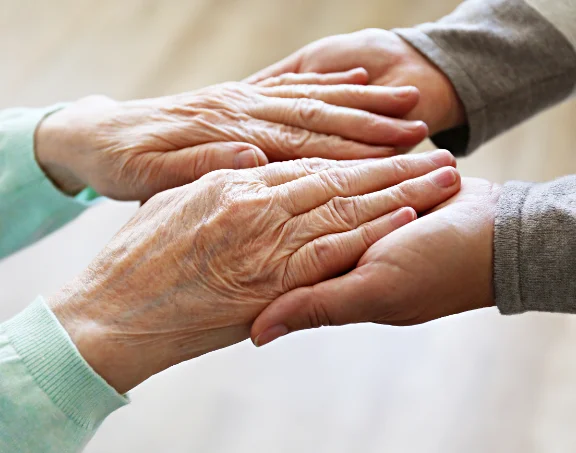
Physical touch is reassuring and lets your grandfather know that he is not alone; someone is with him and comforting him. Reading passages of your grandfather’s favourite book might relax him, and at the end of our visit, we can ensure that his preferred music is left playing for him, extending his peace and contentment even longer.
How Warm Embrace Caregivers enhance life during late-stage dementia:
Human Connection
Being present and sharing a common experience in that moment together.
Seeing someone for who they are as a person, not just administering care to their physical body.
Companionship
Validating one’s life story.
Helping connect the individual to their identity and personal history.
Here Wherever You Are
Although many people with advanced dementia are living in long term care, it is possible to remain living at home through the entire dementia journey. Warm Embrace will support a family wherever their loved one is living.
Here for Your Family’s Needs
Dementia is an individual journey, and services are tailored to match your family’s particular needs. Contact us for more information on how we might support your family’s journey!