

What is Dementia Care?
Dementia Care is providing someone with the support they need to have the best day possible. It is highly customized because each person with dementia has unique needs. Although dementia progresses along a continuum, it is not the same journey for each person.
Professional dementia caregivers know how to match the needs of someone with dementia on a moment-to-moment basis. Something might be fun and enjoyable one moment, and a few moments later, the person with dementia feels overwhelmed and frightened. A professional caregiver can adapt to those rapidly changing needs and adjust the situation to be more comfortable for the person with dementia.
There are many types of dementia, and each impact the brain distinctly by affecting regions of the brain in different ways. That is what causes the variation in symptoms, even between individuals with the same diagnosis.
There is a common thread among people with dementia. It is the need to feel seen and heard and understood. People with dementia want to engage in meaningful tasks, to be helpful and to feel productive. They just need some guidance and cueing to be successful.
Our compassionate care provides the step-by-step cueing needed to guide someone through their day.

Initiate
Suggest an activity and get it started. Demonstrate how to start.
Cue
Provide verbal tips, or gentle touch to signal how to proceed.
Remind
Continual refocusing on the activity at hand, repeat instructions patiently.
Assist
Come alongside and fill in the gaps as necessary to complete the task.
Our Philosophy of Care is All About Empowerment!
Your mother was once a fabulous cook who was the envy of all potluck dinners. Now, it is not safe for her to use the stove when she is alone; she has not made a complete meal in years. What you really need is someone who will help your mother tap into her strengths, her talents, and her identity as a fabulous cook.
Your mother has a sense that she is supposed to be doing something. Being given busy work or meaningless tasks will be frustrating and possibly insulting to her. She wants to do something that matters, something productive. She will delight in providing for her family in the same way that she had been accustomed to for many years.
Encouraging your mother to be involved in activities of which she is capable, ensures that she retains those abilities. If we take over and just do things for your mother, she will lose her capability unnecessarily. Involving your mother keeps her brain active and keeps her suitably challenged.
We believe in engaging, interacting and inspiring clients
Our caregivers are trained to be agents of empowerment!
Our caregivers:
Encourage the person with dementia to maintain their abilities and remain as independent as possible.
Do not rush in and take over for someone
Provide cueing to help someone with the sequencing of events.
Provide reminders
Help someone to initiate a task in the first place
Guide them to remain on task and assist when necessary.
Provide meaningful engagement.

Transforming Dementia Care: From Boredom to Meaningful Living
Boredom is the underlying cause of many so-called ‘dementia behaviours’. Dementia does not change the human desire to be productive. When the brain is not meaningfully occupied, it will create its own occupation!
Providing meaningful activities for someone with dementia is one of the most effective ways to reduce undesired behaviours. However, it can be incredibly time-consuming and does require an enormous amount of patience
Professional caregivers can fill the gap. Professional caregivers can take the abundant time and patience required to keep people with dementia engaged in meaningful activities. Caregivers help clients with dementia to connect to their passions and interests by making activities accessible.
Caregivers modify activities to match their client’s ability level—that might be fluctuating by the day or by the hour—to ensure that activities are never too difficult or too easy and boring. When people are enjoying hobbies that they love, and they are not frustrated or bored, their so-called behaviours are drastically reduced.
What passions might we re-inspire in your loved one, to spark their desire for meaningful engagement and productivity?
Dementia Care for Every Stage

Initiate activities: inspire active joining in, tender cajoling when necessary
emphasize capabilities: create opportunities to showcase abilities

cueing: gentle reminders of the task at hand; demonstrating or physically guiding the task
empowerment: set someone up for success

Providing care: Seeing someone for who they are, not just administering care to their physical body.
Companionship: validating life stories, connecting to identity and personal history.

The Language of Dementia: Listening Beyond Words
People with dementia are constantly communicating. They may not be using words, but their behaviours and reactions are all a form of communication. It is our responsibility to try and understand what they are communicating.
We must remember that people who have dementia were all unique individuals prior to the onset of their illness. They continue to be unique individuals with different personalities, communication styles, interests, life histories, etc. We must never lose sight of the fact that a person with dementia is first and foremost a person who requires love, care, and understanding, not just a disease or a ‘case’ that needs to be managed.
We always seek to understand the meaning behind the personal expression.
How is homecare customized for someone with dementia?

Personal Care
Slow down and match pace
Earn trust first
Explain each step of care
Encourage autonomy and self-care
Meal Preparation
Cooking as a communal task that brings fulfillment
Familiar recipes that spark memory and increase appetite
Feeding assistance when necessary
Cleaning
Encourage involvement with familiar tasks
Showcase success with tasks that are manageable
Create sense of productivity and purpose
Companionship
Listening for the meaning behind the words
Understanding what they are perceiving
Finding moments of joy, familiarity and comfort
Beyond Tasks:
Meeting the Emotional Needs of People with Dementia
People with dementia have emotional needs just as much—if not more—than they did their entire lives. They still feel the entire range of human emotions and often express these emotions more vividly than they ever did previously. The ‘filter’ we have developed over the years that tells us when and how we can express emotions is affected by dementia; thus, someone may be very expressive emotionally for the first time in their life.
Emotional needs are only met when someone else is particularly caring and understanding.
Our caregivers, who have extensive training in dementia, can make educated deductions about what your loved one is trying to express. We can then aim to meet those emotional needs and provide ongoing support to reduce future anxiety.
One of the greatest gifts that we can offer to someone with dementia is the gift of truly relating to that person!
Someone with dementia is experiencing the world around them differently than they previously experienced the world, and differently than you might be experiencing the world around you. This experience may be frightening, overwhelming, or worrisome, and the feelings that are generated and their emotional response is fully valid.
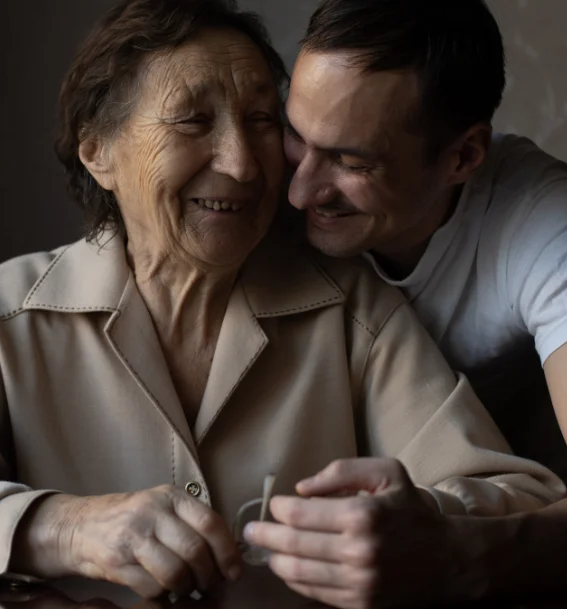
The kindest thing we can do is try to understand the emotional response and validate the feelings that someone else is experiencing. Only then can we attempt to change someone’s experience into something more positive.
Preventing Caregiver Burnout: Plan Ahead with Warm Embrace
All too often people will say: “Dad won’t accept help from anyone else, so I have no choice!”
Then a crisis occurs, and it is Dad who has no choice—he must accept help from another source because you, the family caregiver, are now experiencing your own health issue related to burn out. Sure enough, Dad does accept the help, although it might have been a smoother introduction to care had it not been a crisis.
It will be a kinder transition for your father to accept outside support in a thoughtfully preplanned way, rather than abruptly.
Best of all, your burnout can be prevented in the first place! It is far easier to prevent burnout by providing support early on than it is to recover after burnout has occurred.